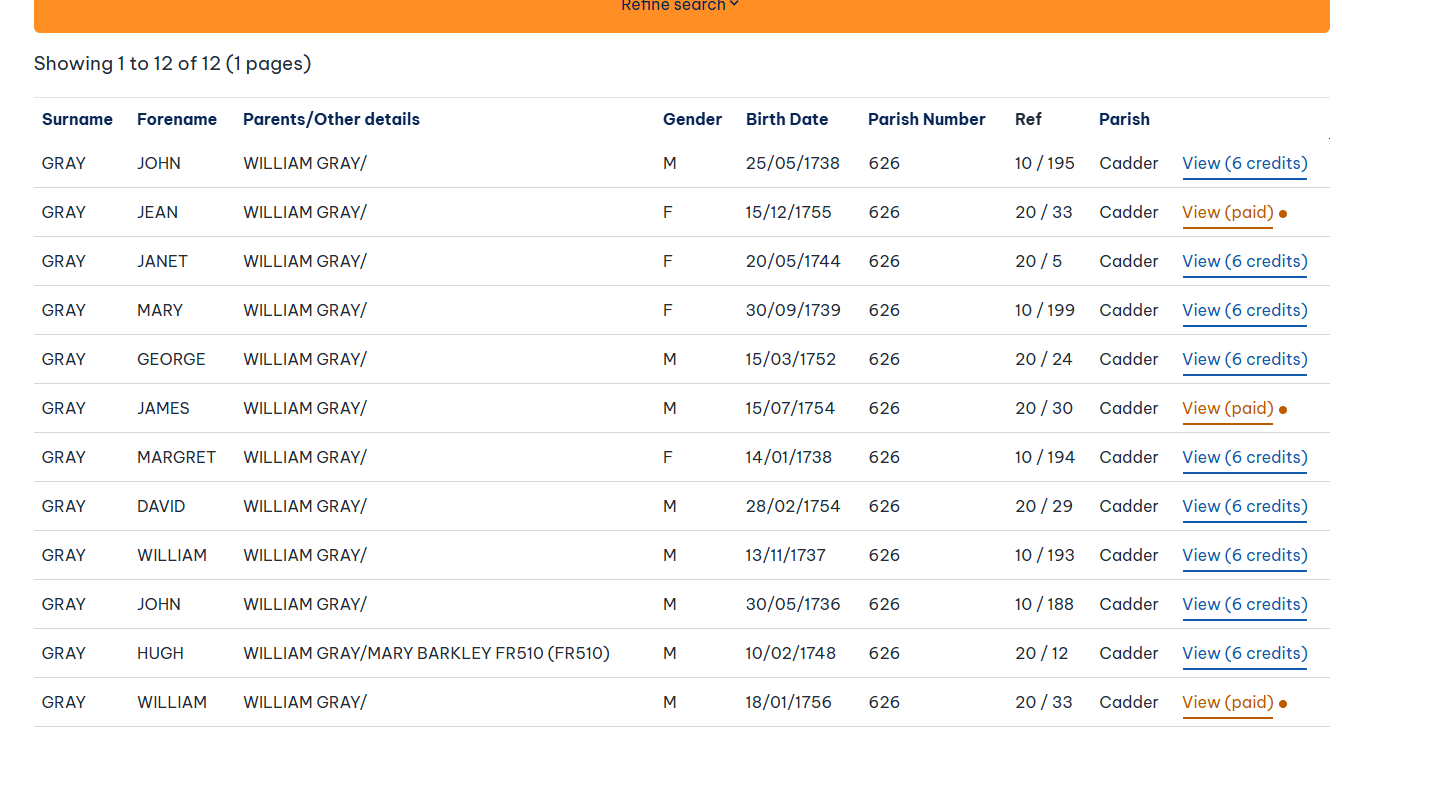
Searching across a household
Indexes help identify potential siblings and repeated family names. Every promising result then needs checking against the original register.
Family story 01 / Scotland and Australia
The Gray family story begins in the historic parish of Cadder in Lanarkshire, with research reaching back to a William Gray baptised in 1724.
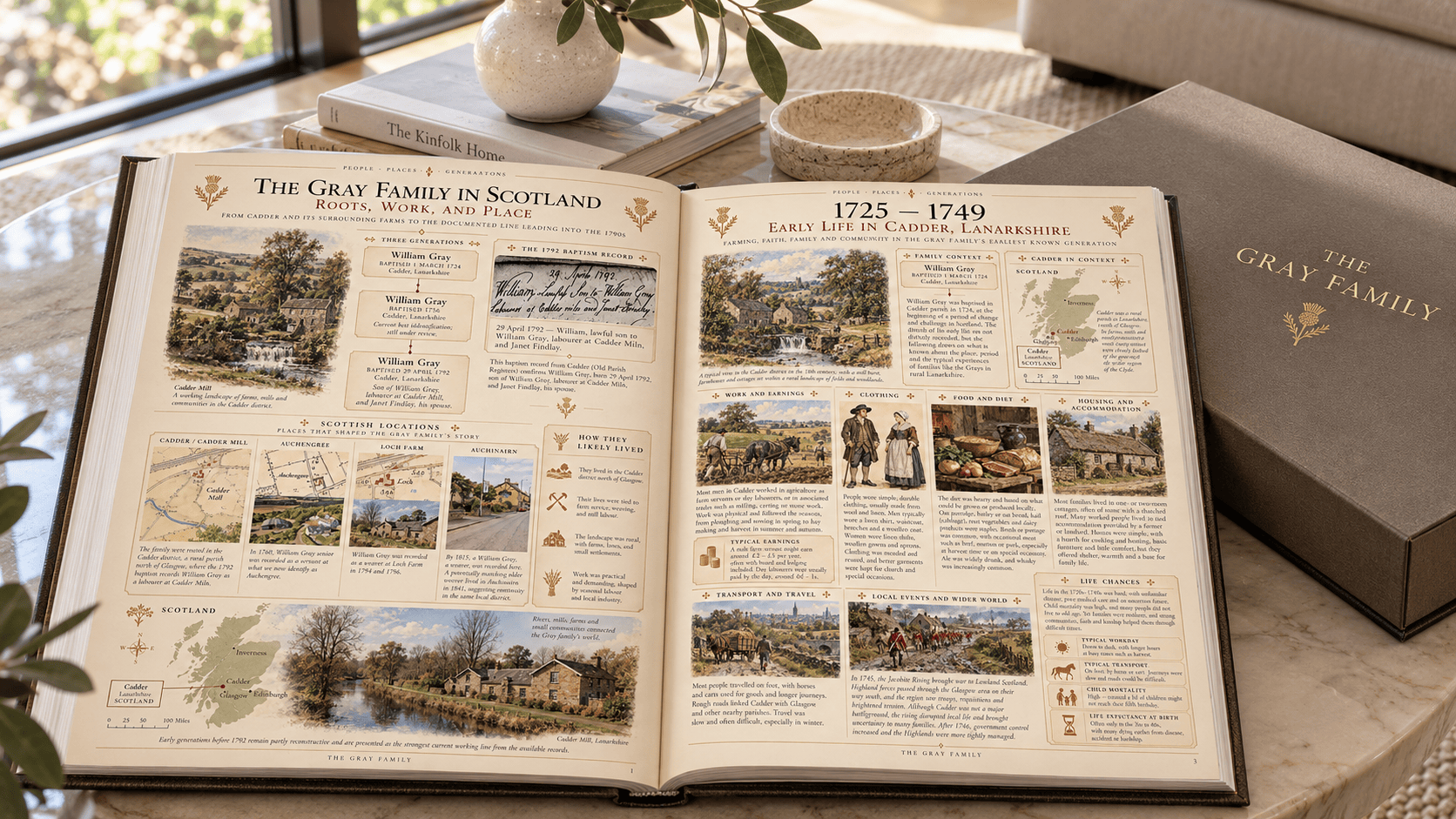
Original parish records, historical maps and the places where successive generations lived provided the foundation. We explored how the family worked, dressed, travelled and lived, so the finished book would be more than a list of names.
The result is a richly illustrated family history, designed to give Lee, Michelle, Calvin and Grace a lasting connection to the generations before them.
The link between the 1724 baptism and the later Gray generations is Strongly Supported, rather than conclusively documented. We make that distinction clear because honest family history matters.
Explore the illustrated heritage booksBehind the Gray family discovery
Long before we could design a legacy artwork, we needed to find the people behind the names. That meant working through original Scottish parish registers, comparing individual entries, and testing how each generation connected to the next.
The documents below are examples from that research, not decorative illustrations. Each is shown with its source and a description of the evidence it provides.
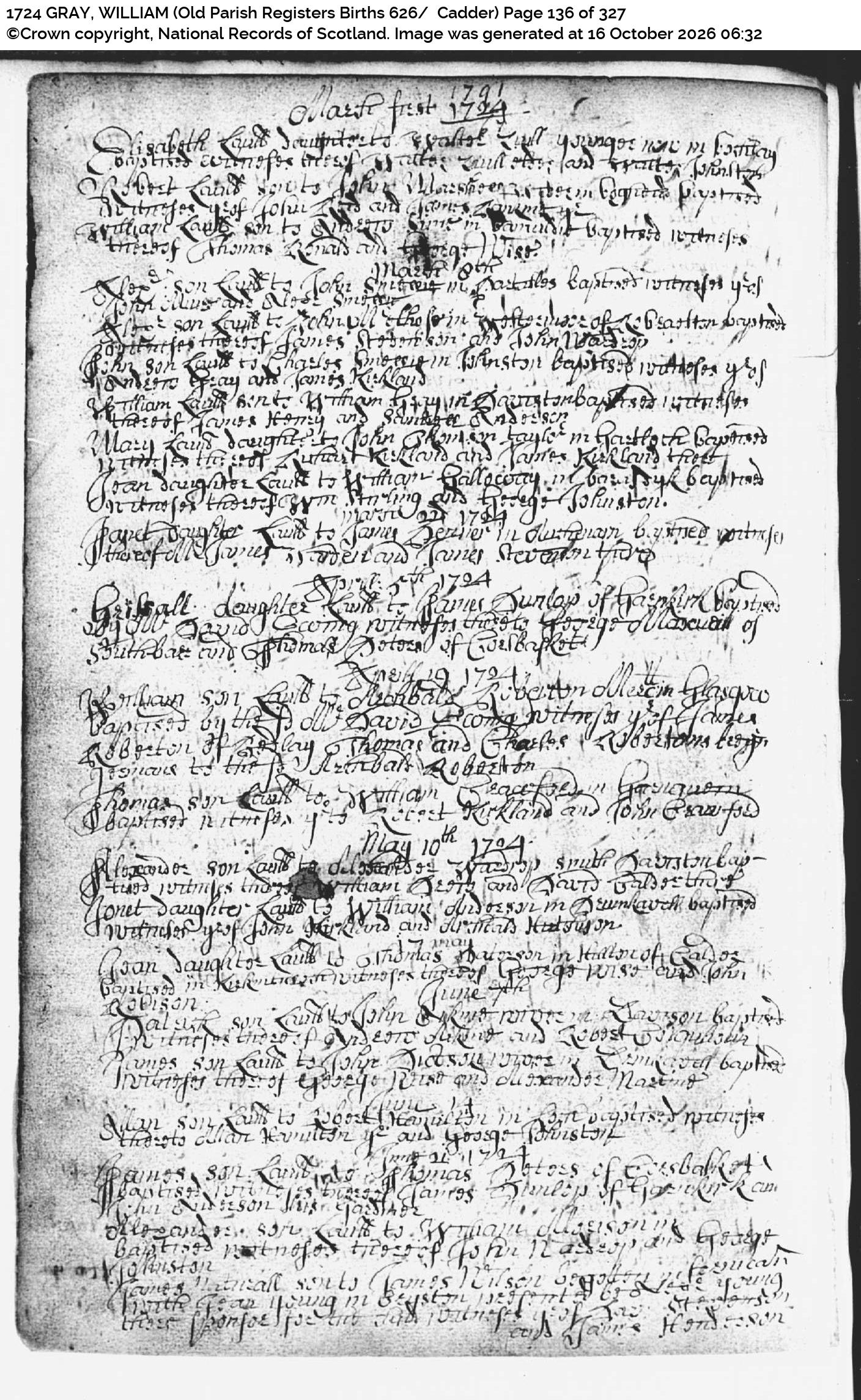
One of the discoveries at the heart of this commission was a baptismal entry for William Gray in the parish of Cadder, Lanarkshire, in 1724.
The handwriting, abbreviated names and closely packed lines show why original records demand careful reading. Identifying a historical name is an important starting point; connecting that person to later generations requires corroborating evidence.
Shown here: the historical register page, retaining its National Records of Scotland attribution.
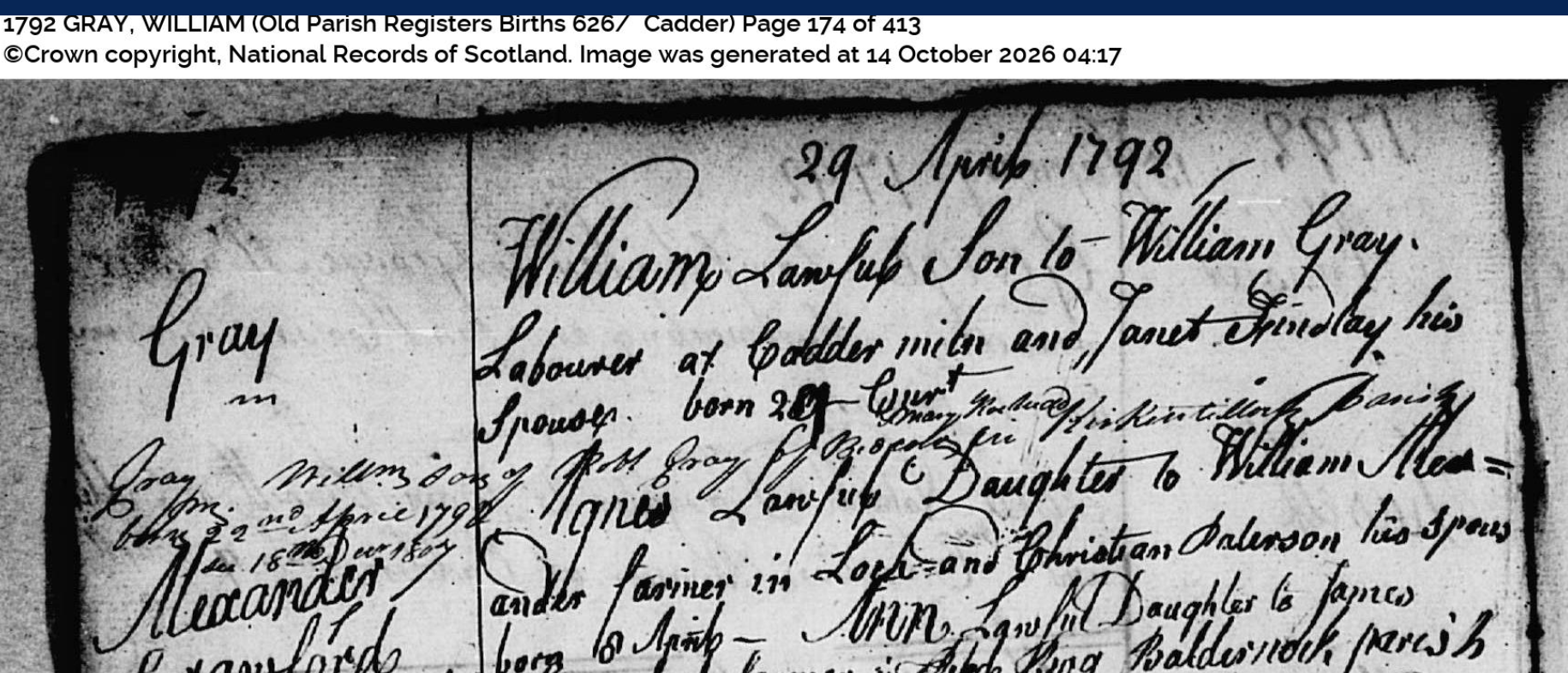
This 1792 register entry identifies William Gray as a lawful son of William Gray, a labourer at Cadder, and Janet Findlay, his spouse.
Details such as a parent's occupation and the mother's name help distinguish people with common names. They become valuable clues when cross-checked against surrounding births, marriages and places.
The entry is evidence of the recorded parent-child relationship, not by itself proof of how that household connects to every later Gray generation.
Indexes help identify potential siblings and repeated family names. Every promising result then needs checking against the original register.
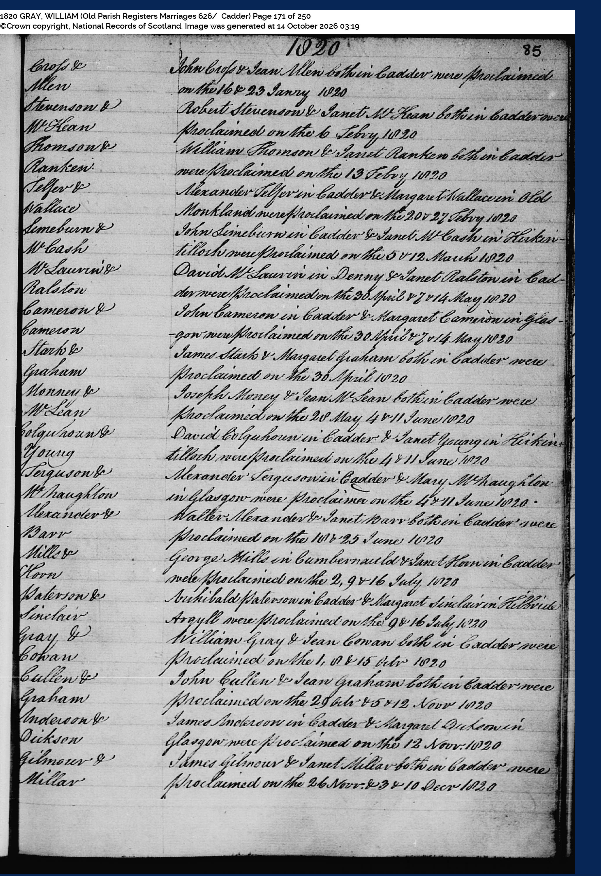
Marriage registers offer another route through a family's history. The 1820 page is an example of how we investigate later connections and verify names.
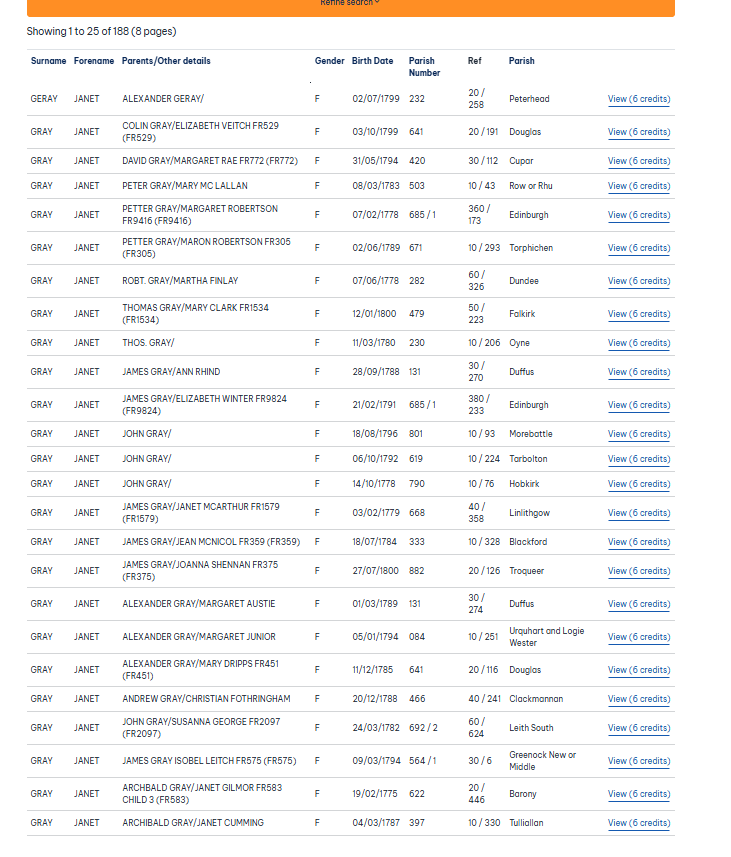
Searching for Janet Gray returns many possible matches across Scotland. Parish, parents and dates must be compared before any one candidate can be assigned to the family.
The finished family legacy
When the documentary work and family narrative come together, the result can be a carefully illustrated heritage book and a framed family artwork. The images of the finished collection are illustrative product presentations.
Explore the Gray family's finished story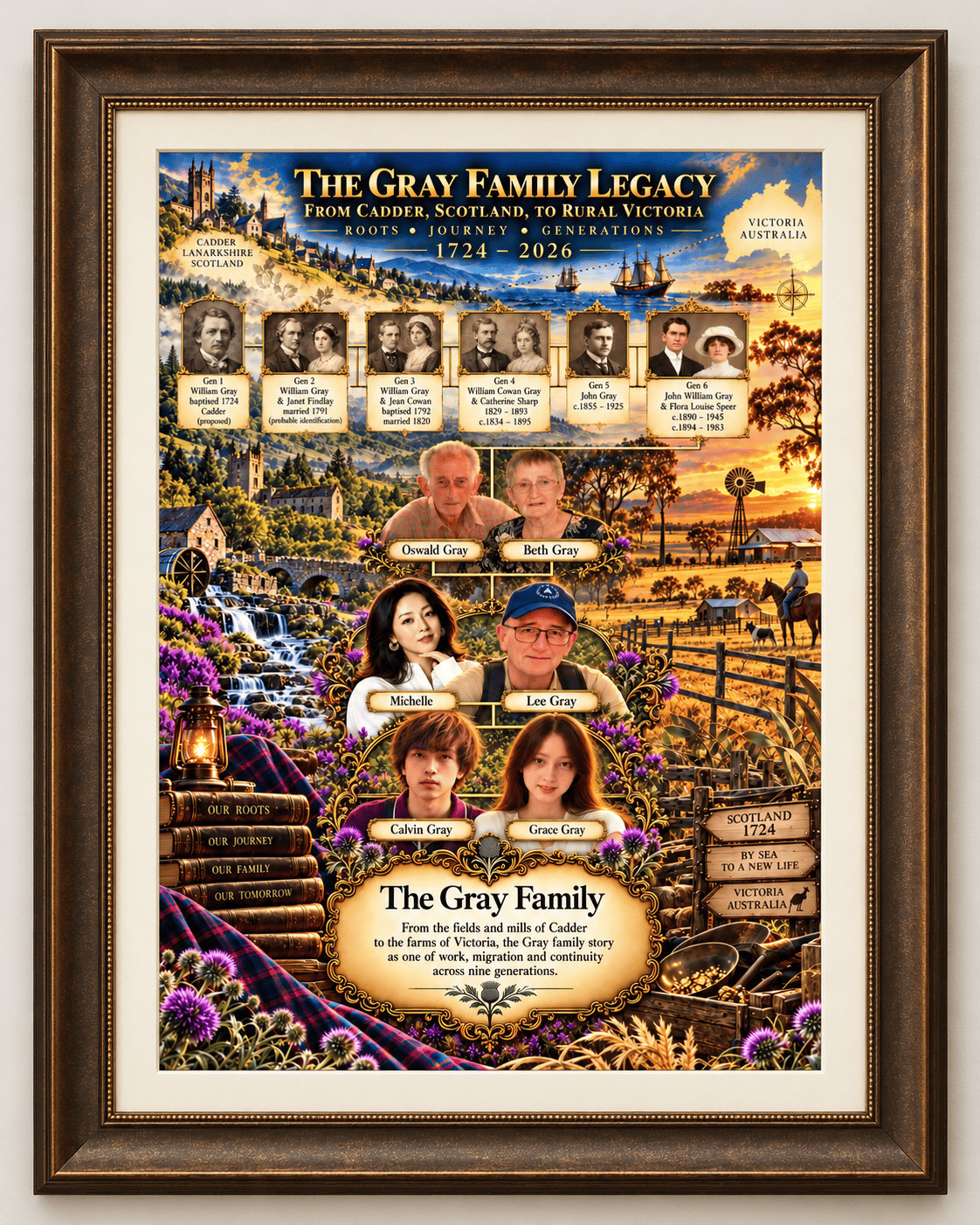
In the family's own words
"I thought Gavin was going to help us discover our family history. I never imagined he would bring nearly 300 years of that history to life."
Lee's account of the Gray family research and the heritage collection created for his family.
"I was absolutely amazed at how Gavin was able to take our family's history all the way back to records from 1724, to a William Gray in Cadder, Scotland.
Before this, I had very little idea of how far back our family history could be traced, or just how much information might still be waiting to be discovered.
What impressed me most was the extraordinary amount of genealogical research Gavin undertook. He worked through centuries-old Scottish parish registers, baptism and marriage records, historical maps and other documents, gradually piecing together the lives of people who had long since disappeared from our family's living memory.
It was fascinating watching the discoveries unfold. One record would lead to another, a place name would reveal a new connection, and slowly a picture of our family's origins began to emerge. Gavin was meticulous about the evidence, explaining which connections were established and which still needed further investigation.
But he didn't simply discover names and dates. He researched the communities where our ancestors lived, the work they did, the conditions they experienced and the historical events that shaped their lives.
For the first time, I could begin to imagine what life was actually like for my ancestors nearly 300 years ago.
And then Gavin transformed the research into an illustrated family history and artwork that brought the generations of our family together in the proofs we were shown.
Seeing my parents, Oswald and Beth, alongside Michelle, myself, Calvin and Grace, connected to those earlier generations in Scotland, was an incredibly moving experience.
One of the unexpected benefits was how useful all this research became for our daughter Grace.
Grace happened to be doing a Year 10 History project on family heritage, and the book and all the historical information Gavin had uncovered provided her with an extraordinary resource. The quality of the book and the depth of information impressed both her teachers and fellow students.
It was wonderful to see our family history become something that Grace could use in her education, share with others and take pride in.
The whole experience has also sparked another interest for me: my wife's family history.
Michelle is Chinese, and it has always been very important to both of us that Calvin and Grace grow up with a good understanding of both sides of their family heritage.
I was fortunate enough to see the remarkable work Gavin had already done researching and illustrating the history of a Chinese family. It made me realise that we could do exactly the same thing for Michelle's family.
Now that we've explored our Scottish roots, we intend to commission Gavin to research and bring to life the Chinese side of our children's heritage as well.
The thought of having both family histories preserved, with all those generations and two very different cultures brought together for our children and their descendants, is something quite special.
I thought Gavin was going to help us discover our family history. I never imagined he would bring nearly 300 years of that history to life.
What this project has already given us is much more than a family tree.
It's an understanding of where we came from, something meaningful to share with our children, and a legacy that will continue long after we're gone.
And now we're looking forward to discovering the other half of our family's story."
Lee Gray Victoria, Australia